vrijdag 24 mei 2013

VARNISH - WOODEN ELEMENTS


We started with a small test to check how to finish the wooden parts. The wooden parts will be made of blank bending triplex and then coated with a transparent varnish. This test was done to see how many layers of varnish the wood should get. Two different types of varnish were bought: dark oak and rural pinewood. Both varnishes were painted on the triplex in 1, 2, 3 and 4 layers. The picture below will show the results.

This has been only the first part of the test. The next part of the test shall include the HIMACS. We are going to mill a piece out of the HIMACS and replace that part with the wooden rectangles. After that, conclusions can be made about the varnish color and the amount of layers. 


woensdag 22 mei 2013

TOUCH SENSOR - TEST - AESTHETICS


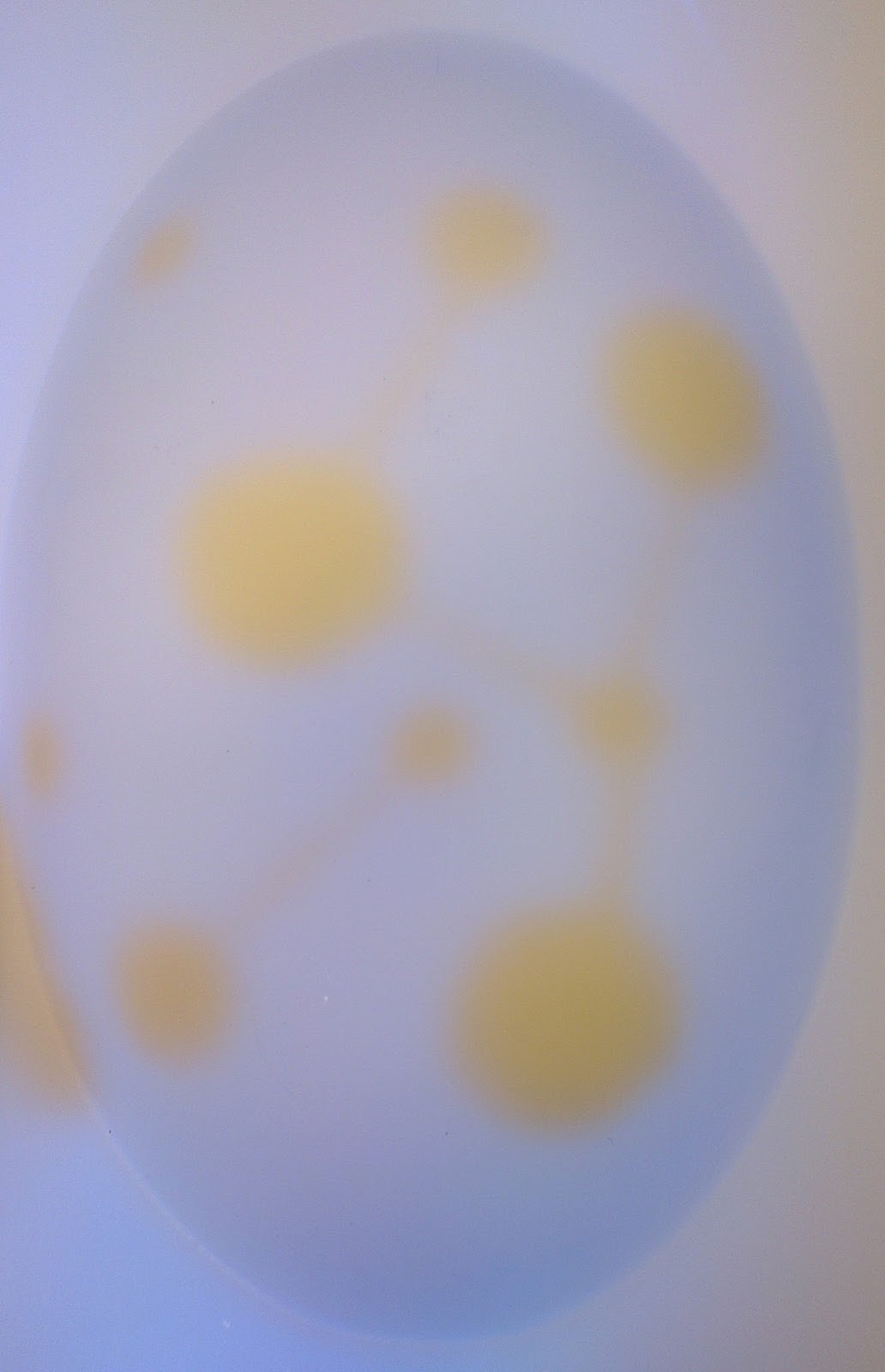
For the prototype we use HIMACS 12mm. The surface of the product is flat, but to make the LUMO aesthetically more appealing we want to make use of a certain pattern. When the LUMO lights are off, the LUMO has an even white color. When interacting with the product, patterns appear, due to the light. After a short analysis of different patterns, we choose for an abstract pattern of stars. Different sizes of circles combined with little strokes. However it was not clear if the material is transparent enough and how small the pattern can be. In this test we were trying to find answers to these questions.

We took a plate of HIMACS 12mm en glued aluminum foil to it in the chosen pattern. Small and larger shapes were used to see how big the smallest shape must be. By using aluminum, this part also functions as an antenna for the touch sensor. It responds on touch; however more research needs to be done on that part. At this moment the touch sensor is too sensitive and the amount of aluminum that is used is too much, in which the antenna is already too big. The LUMO will be on the whole time.

Concluding from this test:
-          The details of the pattern are better shown with a brighter light. The current LEDs are not sufficient enough
-          The TL- lamps in the studio are however sufficient enough
-          The color of the light influences the detailing in the pattern
-          12mm HIMACS does work, when having a sufficient amount of light behind it
-          The smallest shape used has a  size of 3mm. This was more than ok.


woensdag 8 mei 2013

CONSTRUCTION

The LUMO 2.0 consists out of three main elements, namely: Wooden sheets, HIMACS sheets and a framework. The framework is made of aluminium from the 6000 series. It has two tubes and welded to that are aluminium sheets pieces. Some of them are bended, some have holes for the bolts and some are just straight. In the exploded view the different elements can be seen clearly. The wooden part will be on the outside and the HIMACS will be on the inside of the LUMO. The HIMACS will be screwed on to the framework. The bended strips are constructed in such a way that the strip will not block the light. The bolts secures the framework and assembling can be done at the hospital.

The construction is not finished yet and more calculation needs to be done.


ELECTRONICS - HIMACS TOUCH TEST

In the LUMO1.0 prototype the touch sensors worked properly,. However the LUMO 2.0 is made of HIMACS and uses thicker sheets. This test was to find out if the capacitive touch sensors also work with the HIMACS material. We used the electronic components of the previous prototype to set up this test. We made some videos to confirm that it works. 
The material thickness of the wood is 3mm and the himacs has a thickness of 6mm.


maandag 6 mei 2013

LUMO MODEL 1:1 PVC

To get a better feeling of the dimensions we made a 1:1 model of the LUMO. The LUMO has a height of 2 meters. The framework is made from PVC tubes and connected to eachother with tape. We made some pictures of the model while sitting, hanging and standing in the LUMO. This give an impression of the actual size of the product.

One of the conclusions we could make, is that the size is just fine. It is high enough to walk through and to touch te panels above your head. However this height stimulates the children to hang on the LUMO. You can touch the highest height quite easily and it makes you want to swing on it. Also in between the different segments/elements.


LUMO SCALE MODEL FOAM

At first we wanted to make a the LUMO with a 20 degree angle, however the shape was not that extreme as we wanted it to be. So we made a scale  model with a 45 degree angle. To compare the two different angles we made another scale model with the right dimensions and a bit bigger than the previous models. But this model changed our opinion about the angle. How bigger the shape how more extreme the shape appears. So we came to the conclusion to keep an angle of 20 degrees, due to its appearance on a larger scale. 

The LUMO scale model is made out of green foam with the milling machine. 


donderdag 2 mei 2013

USER TEST- VISUAL QUALITY SCAN - FINAL


Participants and method:
For the user test four children participated: an 11 year old girl, a 13 year old girl, a 14 year old boy and a boy of which the age is unknown. The children were asked to choose out of 26 pictures, four pictures they felt attracted to and four pictures which were less attractive. Explanation was given by all chosen pictures.

Results
For the results, gender and age are not that relevant in contrast to the reason why. Both boys and girls will interact with the LUMO, so the overall appearance should fit the target group.
To get a clear overview of all chosen pictures a collage is made; a dislike and a like collage. When scanning over the collages, no clear difference can be seen. Both collages show a combination of colorful products and minimalistic products. However some children mentioned that they liked rhythm and patterns and disliked the product which had no surprising effect. It was not the white and wooden color of the product they disliked, but more the shape in combination with the colors. “It looks boring”: girl 11 years old.  Many of the ‘like’ products also have an extraordinary shape; it is funny, uses rhythm or has surprising colors.
Soft fabrics were surprisingly not chosen as a ‘like’ product: “I do not like the combination of materials and it is to dark”. This statement states, that color is very important, to be liked or not. Some other children also mentioned that the dark colors were not that nice and when looking at the collages many children choose the colorful pictures. Some of them choose the colorful pictures unintentionally, but some of them did mention that they liked the bright colors. 


Design LUMO
o   Use of colors [lights]
o   Use of rhythm and patterns [touch sensors]
o   Surprising shapes or no boring shapes [overall extreme curved shape]